

Dental Bridges
in Newton, MA
Restorative Treatments
Losing a tooth changes more than your smile. Over time, a gap left by a missing tooth can shift surrounding teeth out of alignment, make chewing more difficult, and affect the way you speak. The longer a missing tooth goes unaddressed, the more those changes compound, and restoring that space sooner rather than later is almost always the better path forward.
At Newton Smile Centre, we offer dental bridges as a reliable, natural-looking solution for replacing one or more missing teeth. Our team takes time to evaluate your full oral health picture before recommending any restorative treatment, and we'll walk you through your options with the same transparency and care we'd offer a member of our own family.
What Is a Dental Bridge?
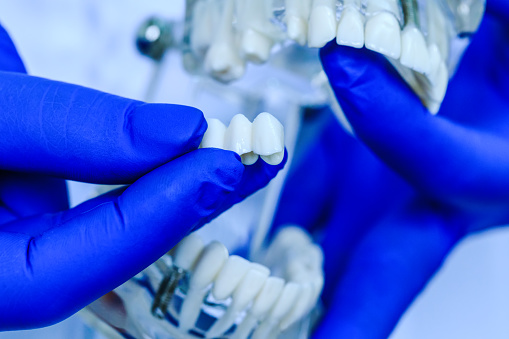
A dental bridge is a fixed restoration that literally bridges the gap created by one or more missing teeth. It consists of one or more artificial teeth, called pontics, held in place by dental crowns that are cemented onto the natural teeth on either side of the gap. Once placed, a bridge functions and looks much like your natural teeth and does not need to be removed for cleaning.
According to the Centers for Disease Control and Prevention, tooth loss affects a significant portion of American adults, with prevalence increasing with age. A bridge is one of the most established and effective options for restoring function and appearance after tooth loss, and for many patients, it remains the most practical choice available.
Types of Dental Bridges
Not every bridge is the same, and the right type for you depends on the location of the missing tooth, the condition of your surrounding teeth, and your overall oral health. We'll assess your situation carefully and recommend the approach that best fits your needs.
The most common types of bridges include:
- Traditional bridge: The most widely used type, anchored by crowns placed on the natural teeth on both sides of the gap
- Cantilever bridge: Used when there is only one natural tooth adjacent to the missing tooth, rather than one on each side
- Maryland bridge: A more conservative option that uses a metal or porcelain framework bonded to the backs of adjacent teeth, requiring less alteration to those teeth
- Implant-supported bridge: Anchored by dental implants rather than natural teeth, offering added stability for patients replacing multiple teeth in a row
Each option has distinct advantages depending on your circumstances, and we take the time to explain the differences clearly so you can make an informed decision about your care.
The Bridge Placement Process
Getting a dental bridge at Newton Smile Centre typically takes place over two or more appointments. Knowing what to expect at each stage can help you feel more at ease going in.
Preparing the Abutment Teeth
At your first appointment, we prepare the teeth on either side of the gap, called abutment teeth, by reshaping them slightly to accommodate the crowns that will anchor the bridge. We then take impressions of your teeth, which are sent to a dental lab where your custom bridge is fabricated. A temporary bridge is placed to protect the prepared teeth in the meantime.
Placing the Permanent Bridge
Once your permanent bridge is ready, you return for a fitting appointment. We check the fit, bite, and appearance carefully before cementing the bridge into place. If adjustments are needed, we make them before finalizing the placement. Most patients leave this appointment with a fully functional, comfortable restoration.
Caring for Your Dental Bridge
A well-made bridge can last many years with proper care. Brushing twice daily and flossing are still essential, though the technique for cleaning under the bridge requires a bit of attention. We'll show you how to use a floss threader or interdental brush to keep the area clean and free of buildup.
Routine checkups also play an important role in the longevity of your bridge. We'll monitor the fit of the bridge, the health of the abutment teeth, and the surrounding gum tissue at every visit to make sure everything is holding up well. If you've had other dental work in the area, such as dental fillings or root canal therapy on an adjacent tooth, we'll factor that into our monitoring as well.
Is a Dental Bridge Right for You?
A bridge is an excellent option for many patients, but it isn't the only one. For patients who have lost several teeth or prefer not to alter their adjacent teeth, natural-looking dentures may be worth discussing as an alternative. We present every option honestly and help you weigh the tradeoffs so you can feel confident in whatever direction you choose.
The most important step is simply getting evaluated. Once we have a clear picture of your oral health, we can provide a straightforward recommendation and a plan that meets both your clinical needs and your goals for your smile.
Restore Your Smile at Newton Smile Centre
Newton Smile Centre is a boutique family practice with a close-knit team that has served patients in Newton, Brookline, and the greater Boston area for years. Dr. Walid Benaissa earned his DMD from Tufts University School of Dental Medicine and completed the Maxicourse at New York University of Dental Medicine. Dr. Talar Kiladjian holds both a Master's degree and DMD from Boston University. Together, they lead a practice built on transparency, personalized care, and a genuine commitment to helping every patient feel at ease.
We are in-network with Delta Dental, Cigna, Aetna, Humana, United Healthcare, and MetLife, and Cherry 0% financing is available for qualifying restorative cases. If you're ready to take the next step toward replacing a missing tooth, we'd love to meet you. Contact our office to schedule a consultation today.