


Understanding how dental insurance works can feel just as complicated as the treatment itself. Whether you are enrolling in a new plan, switching providers, or trying to make sense of a recent bill, the in-network vs. out-of-network distinction plays a major role in how much you actually pay out of pocket. For patients in the Greater Boston area, knowing the difference before you book an appointment can mean real savings across the year.
At Newton Smile Centre, we have been serving Newton Centre and the surrounding Greater Boston communities from our office at 796 Beacon Street. Our close-knit team of general dentists, led by Dr. Walid Benaissa and Dr. Talar Kiladjian, believes that navigating dental insurance should never be a barrier to great care, and reviewing your payment options with our front desk before your visit is one of the easiest ways to plan ahead. Whether you are coming in for a routine cleaning or a more involved procedure, understanding your benefits helps you plan with confidence.
What Does “In-Network” Actually Mean?
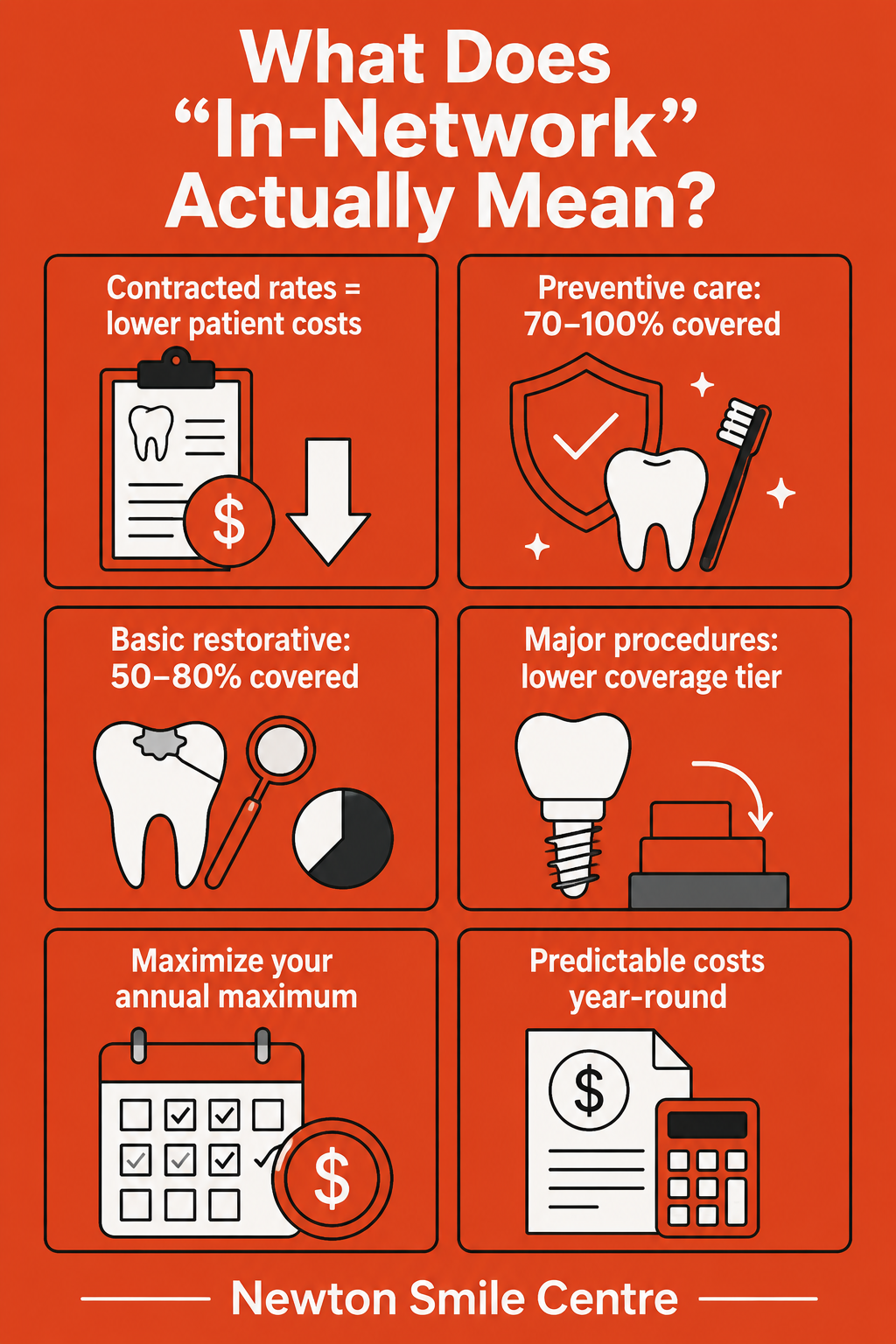
When a dental practice is in-network with your insurance plan, it means the practice has a contract with your insurer and has agreed to charge negotiated, reduced rates for covered services. As a result, your insurance company covers a predictable portion of the bill, and your out-of-pocket costs, including copays and deductibles, are generally lower than they would be with an out-of-network provider.
In most cases, preventive services like professional cleanings and exams are covered at the highest percentage under in-network arrangements, often between 70 and 100 percent. Basic restorative services typically fall in the 50 to 80 percent range, while major procedures such as crowns or bridges are usually covered at a lower rate. Staying in-network helps you get the most out of your annual maximum and keeps your costs predictable throughout the year.
What Happens When You Go Out-of-Network?
Out-of-network simply means the dental practice has not contracted with your specific insurance carrier. According to the American Dental Association, most PPO plans do allow some level of benefit for out-of-network providers, but the coverage structure changes. Rather than paying the negotiated rate, the insurer typically pays based on what it determines to be the “usual, customary, and reasonable” fee, which may be lower than what the dentist actually charges. The difference, known as balance billing, becomes the patient’s responsibility.
This does not mean that visiting an out-of-network dentist is never worthwhile. For some patients, access to a particular team or the level of care offered at a specific practice outweighs the cost difference. What matters most is going in with a clear picture of what your plan covers, so there are no surprises on the back end.
Questions to Ask Before Your Appointment
Before scheduling a procedure, a few quick questions to your insurance provider can save you considerable confusion. Here are the most important ones to ask:
- In-network status: is this dental practice contracted with my plan?
- Annual maximum: what is the most my plan will pay in a single year?
- Coverage percentages: how much does my plan cover for preventive, basic, and major services?
- Out-of-network benefits: if I go out-of-network, what portion will my plan still cover?
- Deductible: has my deductible been met, and how does it affect my out-of-pocket costs?
Asking these questions up front gives you the clearest picture of what to expect, whether you are coming in for general dental services or something more involved.
Financing When Dental Insurance Falls Short
Even with strong insurance coverage, some treatments carry a cost that goes beyond what a plan will pay. This is especially true for patients pursuing cosmetic dentistry treatments such as porcelain veneers or teeth whitening, which are typically not covered at all. It is also common for services such as dental implants or periodontal treatment to exceed plan maximums, leaving a balance after insurance is applied.
For these situations, flexible financing options can bridge the gap. Cherry 0% financing, for example, is available for qualifying cosmetic cases and allows patients to spread treatment costs over time without accruing interest. Understanding both your insurance benefits and any available financing before you commit to a treatment plan helps you approach dental care without financial stress.
Schedule Your Visit at Newton Smile Centre
At Newton Smile Centre, our close-knit team has been together for years and treats every patient the way we would want our own family treated. We accept many major dental insurance plans, including Delta, Cigna, Aetna, Humana, United, and MetLife, and we take the time to help patients understand exactly what their coverage looks like before treatment begins. Our multilingual team speaks English, Portuguese, Spanish, French, and Arabic, and we offer convenient hours to fit your schedule.
If you have questions about your coverage or want to schedule a new patient appointment, we are ready to help. Reach out to our team through our contact form to schedule your visit and let us take the guesswork out of dental insurance for you.