

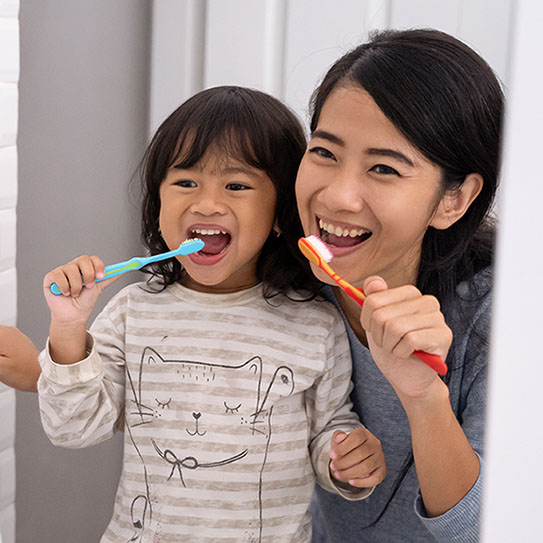
The habits children build around brushing and flossing tend to follow them into adulthood, for better or worse. When those habits are established thoughtfully and early, they become automatic. When they are skipped, rushed, or never properly taught, the consequences show up in the dental chair years later. As a parent, one of the most meaningful things you can do for your child’s long-term health is to make oral care feel like a normal, comfortable part of daily life before they ever have a reason to think twice about it.
At Newton Smile Centre, we care for families across Newton, Brookline, and the greater Boston area, and we see firsthand how much early habits matter. Our dental services include care for patients of all ages, and we take the same warm, attentive approach with children that we do with every patient who comes through our door.
Starting Earlier Than You Think
Most parents wait until their child has a full set of teeth before thinking about dental care, but the window to start is much earlier. The Centers for Disease Control and Prevention recommends wiping a newborn’s gums twice daily with a soft, clean cloth and beginning to brush with a soft toothbrush as soon as the first tooth appears. The first dental visit should happen by the child’s first birthday or within six months of that first tooth coming in, whichever comes first.
Starting early serves two purposes. It removes bacteria and sugars from the mouth before they have a chance to cause damage, and it helps children become comfortable with the sensations of having their mouth cleaned. Children who grow up having their teeth brushed by a caregiver from infancy tend to accept dental care more readily than those who are introduced to it later.
Teaching the Mechanics of Brushing
Children generally lack the fine motor skills to brush their own teeth effectively until around age six to eight. Until then, parents should brush for them or with them, supervising closely and correcting technique. The goal is to establish the right motion and thoroughness before handing over full responsibility.
Toothpaste Amount and Technique by Age
The amount of toothpaste matters as much as the brushing itself. Children under three should use only a smear of fluoride toothpaste, roughly the size of a grain of rice. From age three onward, a pea-sized amount is appropriate. Supervision should continue until the child can reliably spit rather than swallow, typically around age six. Two minutes twice daily is the standard target, and making it a timed, consistent routine using a timer or a song helps younger children understand what is expected.
Introducing Flossing at the Right Time
Flossing becomes necessary as soon as two teeth are close enough together that they touch. For most children, this happens during the toddler years. Parents should floss for their child until the child has enough dexterity to do it independently, which generally aligns with the same window as independent brushing. Oral hygiene instruction at regular dental visits reinforces technique and gives children the tools and language to understand why flossing matters, not just that they have to do it.
Consistency matters more than perfection. A child who flosses imperfectly every day builds a far stronger foundation than one who does it correctly once a week.
Making Dental Visits a Positive Experience
How a child feels about the dentist is shaped almost entirely by their early experiences. Bringing children in for their first visit before any problem develops, and maintaining regular checkups on a six-month schedule, helps them associate the dental office with routine care rather than something that only happens when something hurts.
At Newton Smile Centre, we take particular care with younger patients. We explain what we are doing before we do it, move at a pace the child is comfortable with, and involve parents in the process throughout. A child who leaves a dental appointment feeling calm and proud tends to come back without resistance. Some additional habits that support a positive relationship with dental care include:
- Avoiding negative framing: Phrases like “it won’t hurt” can introduce fear before any procedure begins
- Reading books or watching videos: Familiarizing children with dental office settings before the first visit reduces anxiety
- Praising effort: Celebrating brushing and flossing as accomplishments reinforces the behavior
- Modeling good habits: Children who watch their parents brush and floss take those behaviors more seriously
- Keeping appointments consistent: Regular six-month visits establish the dentist as a familiar, safe presence
These small adjustments in how dental care is framed at home make a measurable difference in how children approach their oral health as they grow.
Building Healthy Smiles at Newton Smile Centre
Preventive care for children is one of the most rewarding parts of what we do at Newton Smile Centre. From fluoride treatments that strengthen developing enamel to dental sealants that protect the back teeth through the cavity-prone years, we offer a full range of preventive services designed to keep young smiles healthy from the very first visit. Dr. Benaissa earned his Doctorate from Tufts University School of Dental Medicine in 2004 and brings a genuine enthusiasm for patient education to every appointment, taking time to walk both parents and children through what good oral care looks like at each stage of development.
Dr. Kiladjian earned her Bachelor of Science in Biological Sciences from Bucknell University, her Master’s in Oral Health Sciences from Boston University School of Medicine, and her Doctorate from Boston University School of Dental Medicine, where her commitment to the profession extended beyond the classroom through active community service and leadership within the American Student Dental Association. Our practice is in-network with Delta, Cigna, Aetna, Humana, United, and MetLife, and Cherry 0% financing is available for qualifying cases. If you are looking for a dental home for your family in Newton, Brookline, or the surrounding area, our team is ready to welcome you. Contact our office to schedule your child’s next visit.